
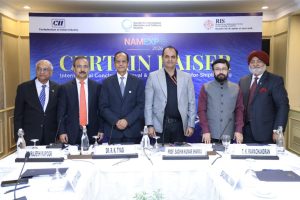
Mumbai, Oct. 23 -- raiser of the NAMEXPO 2026 shipbuilding conclave, the former Shipping Secretary calls for greater collaboration among government, industry, academia, the military and other stakeholders.
Amid the slew of reforms underway in India's shipbuilding sector, developing stronger linkages across the maritime value chain will be critical to transforming the country into a global shipbuilding hub, a former senior bureaucrat has said.
TK Ramachandran, former Secretary, Ministry of Ports, Shipping & Waterways, said that while the grant of infrastructure status to shipping and the passage of five landmark maritime laws marked important milestones, the next challenge is to build a complete maritime ecosystem capable of supporting sustained growth.
"From shipbuilding, repair and recycling, financing, ownership, leasing and chartering, flagging, training and manning, to technical operations, management and insurance, you need the entire ecosystem to be present in the country. We do not even insure ships here on the scale that we should."
He was addressing the media during the curtain-raiser of the NAMEXPO 2026 International Conclave on Naval & Maritime Fusion for Shipbuilding in New Delhi on Thursday.
During Ramachandran's tenure as Shipping Secretary from 2021-25, the Ministry of Ports, Shipping & Waterways outlined a broader vision comprising nearly 300 initiatives to strengthen the country's maritime ecosystem following extensive stakeholder consultations. Expressing satisfaction that many of those measures are now being implemented, he said the focus must shift from policymaking to execution.
"In India, of course, we are very good at policy. But when it comes to implementation, we sometimes begin to falter."
He said collaborative action among government, industry, academia, the military and other stakeholders would be essential to unlocking the sector's potential. While highlighting India's strong naval design capabilities, he noted that these strengths have yet to be adequately translated into commercial shipbuilding.
"We have iDEX (Innovations for Defence Excellence), we have startups, brilliant things are happening, we are building our own submarines. We are building nuclear-powered vessels, and we are building some of the largest warships in the world. And yet we struggle to build a tanker."
According to him, such gaps emphasise the need for greater indigenisation and stronger collaboration across existing institutions, facilities, talent pools and technological capabilities.
"We simply do not manufacture all of them. Nearly 60 per cent of what goes into a ship is still not indigenous; we import it. That is why there is a need to indigenise, there is a need to collaborate, there is a need to utilise the existing facilities, institutions, talent and expertise available in the country."
Demand Spurs Revival
Welcoming recent orders received by Indian shipyards from global shipping lines such as Maersk, CMA CGM and MSC, he said they reflected the success of the government's demand-creation strategy. He contrasted this with the collapse of several domestic shipyards around 15 years ago amid weak demand, inadequate financing and the absence of a supporting ecosystem.
"It was a vicious circle. What we tried to do was break different parts of that cycle and create a virtuous one instead. One way was through demand creation."
Highlighting emerging opportunities, Ramachandran said public-sector oil companies alone are expected to require around 60 ships over the next decade, representing a potential opportunity of Rs.400-500 billion.
"The first order in that series was awarded to GRSE a few months ago, worth around Rs.10 billion. I believe the ball has now started rolling," adding tongue in cheek, "Or perhaps, more appropriately, the ship has started sailing."
Ramachandran said platforms such as NAMEXPO could help accelerate that momentum by bringing together policymakers, industry leaders, researchers and the maritime community to address long-standing structural challenges and create a stronger domestic shipbuilding ecosystem. He expressed hope that the initiative would contribute to what he described as a broader maritime and shipping revolution over the coming decade.
In his special remarks, RK Tyagi, Founding Member, Society for Aerospace Maritime and Defence Studies, and Chairman, Aeronautical Society of India, explained the philosophy behind NAMEXPO. "The oceans connect nations, economies, and societies. Their future cannot be secured by isolating national efforts. It requires synergy and cooperation among various countries, institutions, industries, and technology disciplines."
Emphasising the need to align policy with industry requirements, Sachin Kumar Sharma, Director General, Research and Information System for Developing Countries (RIS), said, "Naval and commercial shipbuilding and shipping require another critical fusion: government and industry. Aligning policy with industry realities is key to turning ideas into action and building a self-reliant Indian maritime sector."
Scheduled for December 1-2, NAMEXPO 2026 will focus on advancing collaboration across ship design, advanced manufacturing, propulsion systems, digital technologies, certification standards and supply-chain development. The conclave will bring together shipyards, maritime companies, original equipment manufacturers (OEMs), technology providers, financial institutions, investors, startups and global maritime stakeholders to explore emerging business opportunities in India's maritime ecosystem.
- Manish Pant
Published by HT Digital Content Services with permission from Infrastructure Today.