
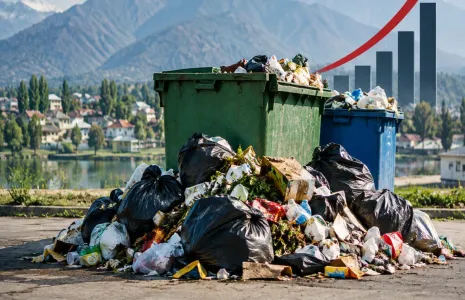
Mumbai, Nov. 27 -- Waste generation in Ganderbal town rose 30 per cent between 2012 and 2020, while inadequate recycling facilities, limited composting infrastructure and uneven municipal services continued to weaken waste management, according to a study of the town's 17 municipal wards. Ganderbal B, Arampora B and Fatihpora A were identified as the three poorly managed wards.
The study drew on surveys of 400 households, interviews with 25 officials and community representatives, municipal records covering 13 years, and geographical mapping. Researchers used Principal Component Analysis (PCA), statistical clustering and Geographic Information System (GIS) mapping to assess waste management performance. None of the wards reached the highest management category.
Municipal records showed daily waste generation increasing from 5 t in 2012 to 6.5 t in 2020. The study linked the pressure to population growth, urban expansion, tourism and industrial activity, noting that Ganderbal serves as a gateway to destinations including Sonamarg, Mansbal Lake and the Amarnath Cave. Recorded generation later fell to about 3.5 t daily during 2022-2024.
Food waste formed the largest part of municipal garbage, accounting for an average of 56 per cent, while plastic and rubber represented 12 per cent. Inert waste, including metals, electronic waste and hazardous materials, made up about 16 per cent. About 80 per cent of surveyed households reported having no nearby composting facility, and the average infrastructure score was 1.41 on a five-point scale.
Only 40 per cent of households said they regularly recycled waste, while 33 per cent reported available recycling facilities and 45 per cent said such facilities were unavailable. Daily collection reached 60 per cent of households, with the remainder receiving services every two to three days. The study recommended decentralised composting, vermicomposting, stronger electronic waste systems, improved bin clearance, better monitoring and ward-specific interventions. It also found that 14 wards were moderately managed, while five ranked as high-performing and five as low-performing under statistical clustering.
Published by HT Digital Content Services with permission from Construction World.