
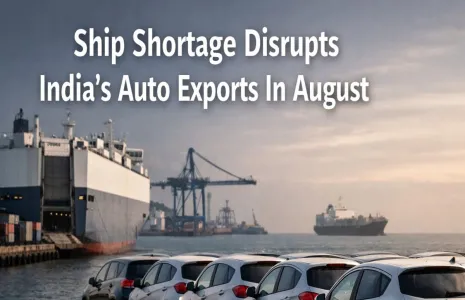
Mumbai, Sept. 7 -- India's automobile exports encountered disruption in August after a shortage of vessels, a problem linked to the ongoing conflict in West Asia which constrained international shipping. The disruption affected major manufacturers including Maruti Suzuki India Ltd and Hyundai Motor India Ltd, reducing the flow of vehicles from Indian ports to overseas destinations. Maruti Suzuki exported 33,844 vehicles in August, marginally lower than 36,538 units in the corresponding month last year.
Maruti's senior executive for corporate affairs reported that demand across markets remained strong and that inventory was available at ports but that liner ships were not available to carry the cars, noting that the problem may continue for a while. The company highlighted diversification across 120 markets, with significant presence in Latin America that necessitates longer voyage times and greater exposure to vessel availability. Management characterised the disruption as temporary and said export momentum was expected to remain resilient.
Despite the logistical constraints, Maruti exported 188,636 vehicles during April to August, registering a 14.1 per cent increase over the corresponding period last year, underscoring continued demand. Between April and July, Maruti exported more vehicles than the other 17 manufacturers from India combined, which gave the company more than 50 per cent of the country's passenger vehicle export market. The firm indicated that shipments to the Middle East continued despite the regional tensions.
The Fronx SUV became the fastest SUV from India to cross 200,000 exports, achieving the milestone in less than 38 months, while the electric SUV e Vitara crossed 46,000 exports in its first 12 months and is being shipped to around 50 countries. These product-specific milestones were cited as evidence of sustained international demand.
Hyundai Motor India acknowledged that total exports in August were impacted by logistical constraints linked to the West Asia conflict and the broader geopolitical environment but remained optimistic about future demand as the situation improved. Industry participants described the vessel shortage as a temporary operational challenge rather than a fundamental shift in overseas demand. Companies are monitoring ship availability while maintaining production and port inventory to ride out the disruption.
Published by HT Digital Content Services with permission from Construction World.