
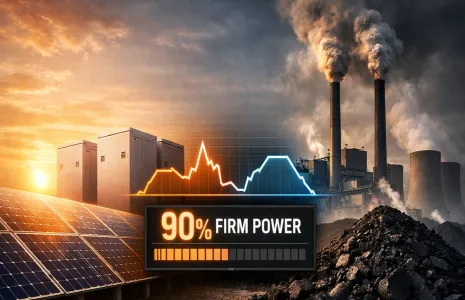
Mumbai, Aug. 31 -- SECI's FDRE-RTC-V tender for 1,000 MW seeks firm power at 90 per cent of capacity during six evening-to-morning peak hours and discovered a tariff of Rs5.25 per kWh. Delivery will be assessed in 15-minute blocks and the study said shortfalls will attract a penalty equivalent to 1.5 times the applicable tariff. The profile restricts midday deliveries to reflect solar abundance.
The analysis compared the tariff with coal power purchase agreements signed in 2025 that started at Rs5.38-Rs6.30 per kWh, with a midpoint of Rs5.84 per kWh. Applying CERC fuel escalation of 2.61 per cent annually lifts the midpoint towards Rs6.4 per kWh by 2036 and to about Rs7.4 per kWh by 2050. Adjusting Rs5.25 for four per cent inflation over 25 years yields Rs3.79 in today's rupees.
Using Rs95 to the dollar, Rs5.25 per kWh equates to about 55 dollars per megawatt-hour (MWh). With an assumed three per cent annual rupee depreciation the dollar price could fall to about 41 dollars per MWh by 2036 and to around 27 dollars per MWh by the contract end.
The study said the tender seeks to align supply with India's net load and to mimic the shape that coal plants provide. Net load approaches a 211 gigawatt (GW) peak at six PM and falls to about 69 per cent of that level at midday. Batteries, rather than panels, determine design because the profile requires 11 gigawatt-hour (GWh) across 14 non-solar hours and about 12 GWh of usable storage after losses.
IECC modelling indicated that a configuration of three gigawatt alternating current (GW-AC) of solar and 12 GWh of battery per one GW of firm capacity can meet the profile at about Rs5.15 per kWh, below the discovered Rs5.25, with penalties around 0.5 per cent of revenue. The tender could enable open access procurement of firm clean power for energy intensive industries.
Published by HT Digital Content Services with permission from Construction World.