
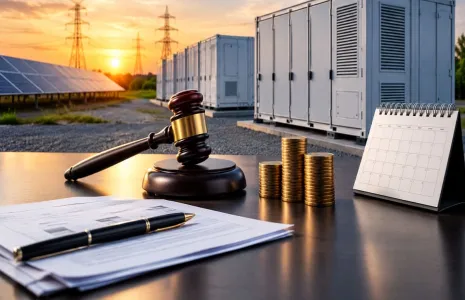
Mumbai, Nov. 16 -- The Ministry of Power has proposed extending statutory late-payment safeguards to independent energy storage service providers, bringing standalone battery and other storage projects within the Electricity (Late Payment Surcharge and Related Matters) Rules, 2022. The amendment is intended to protect storage companies from delayed payments by distribution utilities and improve financing certainty for developers.
The proposal addresses a regulatory gap affecting independent storage developers, who do not currently receive the same payment protections as conventional generators and transmission companies. The ministry expects the changes to improve payment certainty, reduce financing costs and encourage investment in battery energy storage systems (BESS) and pumped hydro storage projects.
The existing rules require electricity bills to be paid by the due date specified in the relevant agreement. Where no date is specified, payment must be made within 45 days of the bill being presented. The late-payment surcharge is linked to the State Bank of India's one-year marginal cost of funds-based lending rate applicable on 1 April of the relevant financial year, plus 5 percentage points. The rate rises by 0.5 percentage points for each subsequent month of default, subject to a ceiling of 3 percentage points above the base rate.
The framework also requires distribution licensees to maintain an unconditional, irrevocable and adequate payment-security mechanism, which can include a letter of credit or a letter of credit backed by an escrow account. Restrictions on electricity procurement apply when distribution companies leave dues unpaid for extended periods. Short-term access is regulated after two-and-a-half months, while long- and medium-term access face restrictions after three-and-a-half months, with the reduction increasing by 10 percentage points for each subsequent month.
The proposed amendment would cover independent providers offering storage as a service or supplying electricity through storage systems, subject to specified ownership exclusions. India's BESS capacity is projected to rise from around 15 GWh in October 2026 to 321 GWh by 2035-36, while pumped hydro storage is expected to increase from 44 GWh in September 2026 to 630 GWh. The ministry said stronger payment protection could support investment, grid stability and greater use of renewable power.
Published by HT Digital Content Services with permission from Construction World.