
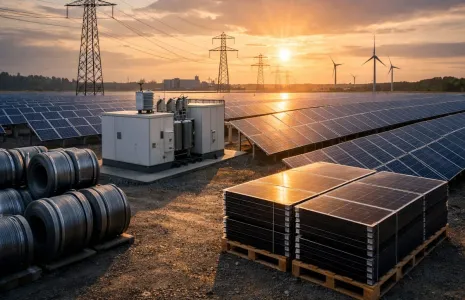
Mumbai, Aug. 28 -- Industry experts said that large scale solar parks can play a key role in making renewable energy more financially viable and supporting India's green transition, but cautioned that realising that potential will require coordinated investment in infrastructure and manufacturing. They argued that bringing together policy support, industry participation and large scale projects helps reduce costs and strengthens the sector's long-term prospects. The experts noted that these parks also create economic activity in remote areas and can unlock land that was previously unused.
Sanjay Ganjoo, director general of the Indian Federation of Green Energy, urged investment in technologies that extend the period during which solar power can be generated and in mechanisms to evacuate electricity from high potential regions such as Ladakh. He pointed to projects including the Khavda solar park as examples of how otherwise marginal land can be utilised to produce electricity for domestic use. Ganjoo also emphasised the need to strengthen the domestic supply chain so that wafers and batteries are produced locally and research and manufacturing receive greater investment.
Mohammad Rihan, director general of the National Institute of Solar Energy, said large solar parks have improved financial viability by aligning policy, industry and infrastructure, driving down prices and supporting sector growth. He noted that the projects have generated employment and local economic benefits in challenging locations. Rihan added that solar installations had reached 165 gigawatt (GW), module manufacturing capacity had crossed 213 GW and cell manufacturing capacity stood at more than 30 GW, signalling progress towards longer-term renewable targets.
Looking ahead, the experts said India will need to combine large scale renewable projects with stronger transmission links, enhanced technology development and deeper domestic manufacturing to increase energy self-reliance. They recommended focused investment in power evacuation infrastructure for remote sites and in storage or generation extending technologies to make solar output more reliable. The consensus was that while large solar parks will continue to be central to the green transition, complementary measures will determine how quickly capacity can be expanded.
Published by HT Digital Content Services with permission from Construction World.