
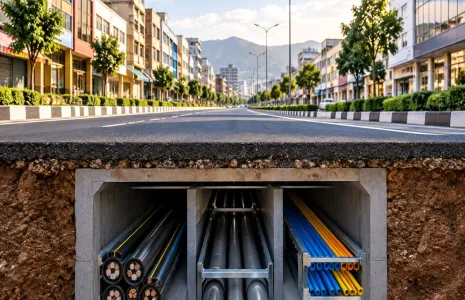
Mumbai, Oct. 30 -- Jammu is set to receive an underground communication corridor between Purani Mandi Chowk and Bharat Mata Chowk at an estimated cost of Rs. 11.9 mn under the Scheme for Special Assistance to States for Capital Investment (SASCI). The project is intended to remove overhead cables, limit repeated road excavations and improve conditions along the busy commercial stretch.
It has been proposed along the road adjoining Raghunath Bazaar, a prominent commercial-cum-residential area developed as a high street by Jammu Smart City. The route has accumulated communication cables installed by government and private service providers over several years. Although most operators have laid their main optical fibre networks underground, last-mile connections to homes and businesses still run overhead, creating hanging wires, cable loops and irregular crossings.
Under the plan, two 200-mm diameter ducts will be placed on opposite sides of the road and encased in concrete. One duct will carry operational cables, while the second will be reserved for future expansion and emergency requirements. Communication manholes will be built at road crossings and at intervals of about 25 to 30 metres to support cable installation, inspection, jointing and maintenance. Distribution boxes will be installed after roughly every eight to 10 buildings, with handholes at intervals of about two buildings for individual connections.
The common infrastructure will serve telecom operators, internet service providers and cable television operators, including BSNL, Airtel, Reliance Jio and Vodafone Idea, while allowing each to retain its independent network. Dedicated conduits will connect buildings, and arrangements will support shifting cables between sides of the road. Cable joints currently suspended from utility poles will be placed inside manholes, providing protection from weather and accidental damage. The design also accommodates future connections, reducing the need for fresh excavation as demand grows. The corridor is intended to reduce damage to road surfaces and underground utilities, minimise traffic disruption during repairs and improve safety by removing low-hanging wires that can interfere with tree branches and streetlights.
Published by HT Digital Content Services with permission from Construction World.