
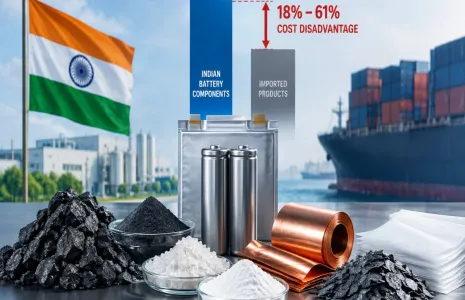
Mumbai, Nov. 9 -- Indian battery component manufacturers face a cost disadvantage of 18% to 61% against imported products, according to a study on accelerating the country's advanced chemistry cell (ACC) component manufacturing ecosystem. The report examined data from more than 20 Indian companies across cathode and anode materials, electrolytes, separators and copper foil.
Higher raw material prices are the main source of cost pressure for cathode materials, electrolytes and copper foil. For graphite anodes, conversion and energy costs, depreciation and financing increase the burden, while separators face challenges from high capital requirements, imported technology and low initial plant utilisation.
The study found that establishing cathode or anode plants in India costs more than twice as much as in China. Borrowing rates for Indian manufacturers range from 8.5% to 16%, compared with about 3.1% in China, while supplier qualification by cell makers generally takes 18 to 24 months and can keep new facilities underutilised during their early years.
China accounted for 99% of global LFP cathode material supply in 2025, alongside 90% of anode material, 93% of electrolyte, 85% of separators and 74% of copper foil, based on JP Morgan and Nomura data cited by the study. India's battery demand is expected to rise from about 33 GWh in 2025 to 236 GWh by 2032 and nearly 600 GWh by 2037, while existing domestic capacity covers less than 3% of projected 2032 cathode, anode and electrolyte needs.
The report proposed three support options: a 25% capital subsidy with sales-linked incentives covering about 30% of the cost gap; operating incentives alone covering about 60% of the gap for five to seven years; or a 50% capital subsidy released alongside investor spending. It also recommended a national testing and certification network, support for battery-grade raw material processing, domestic plant and machinery production, and integrated battery-material clusters. The study was prepared by Netzero Energy Transition Alliance with ARCI, CSIR-NCL, IIT Madras and Deloitte.
Published by HT Digital Content Services with permission from Construction World.