
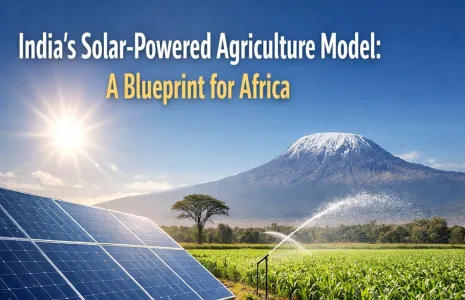
Mumbai, June 26 -- Prime Minister Narendra Modi in New Delhi emphasised India's growing role in advancing sustainable agriculture through clean energy, saying the country's model of harnessing solar power for farming offers a scalable solution for Africa. He framed the development as strengthening shared prosperity, empowering rural communities and enhancing food security, and presented it as a source of national pride for farmers. The comment was posted on the social media platform X and accompanied an article shared by a union minister. The article was presented as highlighting cross border opportunities.
The article cited initiatives such as the Pradhan Mantri Kisan Urja Suraksha evam Utthaan Mahabhiyan (PM-KUSUM) and the International Solar Alliance (ISA) as key drivers in promoting solar powered agriculture and expanding access to clean energy. It explained how policy support, deployment of solar irrigation systems and targeted schemes can reduce reliance on conventional fuels, increase reliability of water supply for crops and improve farm incomes. The presentation positioned these programmes as practical components of a transferable model.
According to the authors, India's experience demonstrates that renewable energy integration can improve farm productivity and strengthen climate resilience by stabilising input supplies and powering irrigation sustainably. The narrative set out links between solar pumps, decentralised generation and more predictable energy access, which in turn can enable more timely sowing and harvesting and reduce post harvest losses. It also described capacity building, financing mechanisms and cooperative approaches as important enablers without offering detailed metrics.
The ministry commentary and the shared article underlined international cooperation as central to scaling the model, with the International Solar Alliance cited as a platform for knowledge exchange and technical collaboration. Observers were invited to consider adaptation of the approach to local contexts in Africa and elsewhere, with emphasis on inclusive benefits for smallholders. The account framed India's solar revolution as a pathway to broader food security and sustainable agricultural development.
Published by HT Digital Content Services with permission from Construction World.