
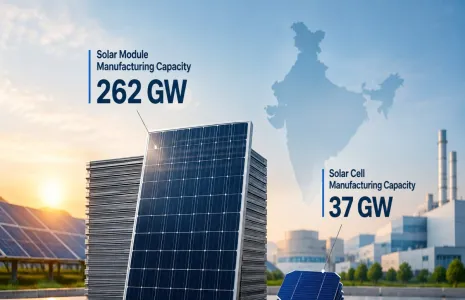
Mumbai, Nov. 5 -- India has reported solar module manufacturing capacity of about 262 GW, compared with around 37 GW of cell capacity as of October 2026, highlighting a significant imbalance in the renewable-energy supply chain. The gap has emerged as manufacturers expand module production while domestic availability of cells and upstream components remains more limited.
Solex Energy is considering investments in the United States as part of a $1.5 bn roadmap through 2030, according to chairman and managing director Chetan Shah. The Gujarat-based company currently operates a 4 GW module facility and plans to increase module capacity to 10 GW. It is also establishing 10 GW of cell capacity and 2 GW of ingot and wafer production.
The proposed US facilities remain under evaluation, with locations, investment requirements and other details yet to be disclosed. Solex is assessing the opportunities in response to US demand for clean-energy components and trade conditions affecting Chinese imports. The company has not announced a construction schedule or final investment allocation between India and the US.
The capacity figures require caution because installed capacity does not necessarily represent operating output. Shah said much of India's module capacity uses older mono PERC technology and that several facilities are non-operational, while newer plants have been established for TOPCon modules. The information available does not provide utilisation rates, production volumes or a technology-wise breakdown of functioning plants, preventing a precise assessment of the effective gap.
The issue also has implications for India's Approved List of Models and Manufacturers framework, or ALMM-II, which links solar deployment to approved domestic sourcing. Shah said the industry supports the government's objectives but has sought an extension of ALMM-II by at least 12 months because of current cell availability. That remains an industry request rather than a government decision.
Solex's plans illustrate the need to assess manufacturing strength by operational capacity and supply-chain depth rather than headline announcements alone. The company's next disclosures will need to clarify the commissioning timeline for its Indian facilities, the usability of existing module capacity and the location and scale of its proposed US projects.
Published by HT Digital Content Services with permission from Construction World.