
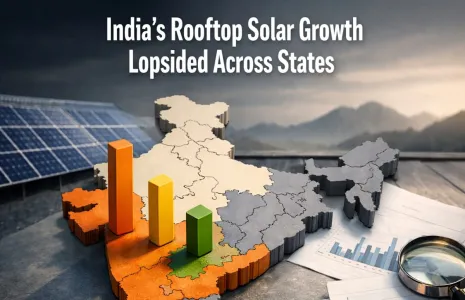
Mumbai, July 2 -- A new analysis finds that India is rapidly expanding rooftop solar capacity but the growth is highly uneven across states. The report indicates significant additions concentrated in western and southern regions while large parts of the east and northeast remain underdeveloped. The study measures capacity in megawatt (MW) and compares state-level deployment using recent central data.
As of March, Gujarat stood at 6,882 MW, Maharashtra at 5,442 MW and Kerala at 1,850 MW of rooftop installations, reflecting strong uptake in those states. The analysis attributes the concentration to stronger market development, more supportive state policies, higher urbanisation and greater availability of financing and technical services in those regions. These factors have helped commercial and residential consumers adopt distributed solar more rapidly than in other areas.
By contrast, eastern and northeastern states recorded much lower deployment: Odisha at 156 MW, West Bengal at 67 MW, Jharkhand at 95 MW and Assam at 344 MW. The analysis notes that the uneven rollout leaves large populations without access to local clean generation and reduces opportunities for local economic benefits. It also observes that grid constraints, limited consumer awareness and weaker incentive programmes in some states have impeded wider adoption.
Meeting national targets of a 47 per cent cut in emissions intensity of gross domestic product and achieving 60 per cent non-fossil installed power capacity by 2035 will require more balanced expansion across all states. The report recommends targeted state-level programmes, improved grid integration, streamlined permitting and enhanced financial support to accelerate rooftop uptake in lagging regions. Effective coordination between central and state authorities, combined with local implementation, is presented as essential to close the regional gap.
Published by HT Digital Content Services with permission from Construction World.