
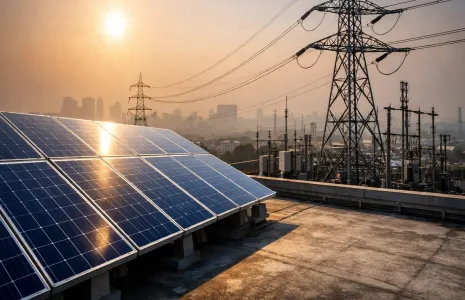
Mumbai, July 3 -- India's rooftop solar roll-out has accelerated across urban and industrial rooftops in response to supportive policy and falling module costs. Homeowners, small businesses and commercial facilities have invested in rooftop photovoltaic systems to cut electricity bills and hedge against supply volatility. The expansion has reduced reliance on centralised generation at peak daylight hours and supported national renewable targets. Rapid uptake has exposed limitations in distribution networks that were designed for one-way power flows.
Distribution transformers and local feeders are experiencing increased instances of reverse power flow and voltage excursions, which network engineers identify as signs of stress. At midday, demand for grid supply falls even as solar output peaks, creating challenges for tariff design and cash flows at state distribution companies. Net metering arrangements have transferred part of the financial burden to grids and created settlement complexities. These operational issues have prompted technical audits and reassessment of planning paradigms.
Grid operators are deploying smart inverters and advanced monitoring systems to manage voltage and frequency deviations and to enable controlled injections. Time of day tariffs and aggregation of rooftop assets are being trialled alongside battery energy storage to shift or absorb excess generation. Investment in grid modernisation, including transformer upgrades and digitised control systems, is under consideration to accommodate two-way flows. Private finance and public funding windows are being aligned to de-risk longer term projects.
Regulators are revising interconnection standards and exploring incentive frameworks that tie remuneration to grid services rather than simple energy export. Manufacturers and installers are adapting product specifications to meet technical requirements and compliance checks. The transition from rapid deployment to integrated operation requires coordinated action by regulators, distribution companies and the rooftop industry. The result will be a more resilient system that preserves consumer benefits while maintaining grid stability.
Published by HT Digital Content Services with permission from Construction World.