
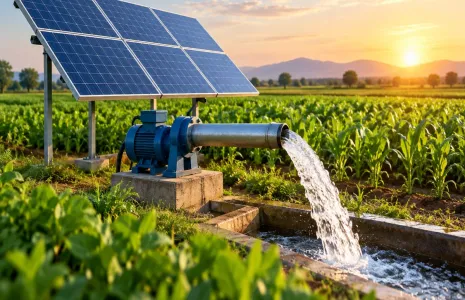
Mumbai, Nov. 10 -- India's agricultural sector could generate demand for an additional 116 GW of solar modules, creating a major market opportunity for domestic manufacturers as the government expands efforts to solarise irrigation pumps and reduce dependence on conventional electricity and diesel, according to a report by the Indian Solar Manufacturers Association (ISMA). The report, titled Powering the Farms, Building the Factory, estimates that grid-connected irrigation pumps could account for 100 GW of additional demand, while diesel-powered pumps could contribute another 16 GW, excluding those in groundwater-stressed areas.
With nearly 23 mn irrigation pumps across the country, agricultural solarisation could become a significant source of long-term demand for India's solar manufacturing industry. It would also connect the clean energy transition with efforts to expand domestic production capacity. The report was launched at the Bharat RE Summit on November 2 and identifies the Pradhan Mantri Kisan Urja Suraksha evam Utthaan Mahabhiyan (PM-KUSUM) as a key driver of the opportunity.
PM-KUSUM added a record 7.6 GW of solar capacity in FY26, while more than 2.8 mn irrigation pumps had been solarised by July 2026, the report said. Domestic Content Requirements (DCR) under Components B and C have helped direct demand towards Indian manufacturers. Installations under the two components reached 13.8 GW by October 2026, meeting nearly two-thirds of the 20.8 GW in domestic manufacturing demand originally projected, ISMA said.
Agriculture accounts for 17.88 per cent of India's electricity consumption, while tariff subsidies billed by distribution companies (DISCOMs) doubled from Rs. 121 bn in FY20 to Rs. 241 bn in FY25. Solarising pumps and feeders could improve electricity availability for farmers, support more sustainable consumption and reduce the financial burden of subsidised agricultural power.
ISMA Secretary General Amit Manohar said the estimated demand linked agriculture with domestic solar manufacturing ambitions, but sustaining the opportunity would require policy support, DCR compliance and predictable project pipelines. The report recommends state-wise targets, multi-year tenders, faster land and clearance processes, and improved grid connectivity. It also calls for investment in upstream capabilities such as silicon wafers and ingots, with actual orders depending on implementation and procurement over multiple years.
Published by HT Digital Content Services with permission from Construction World.