
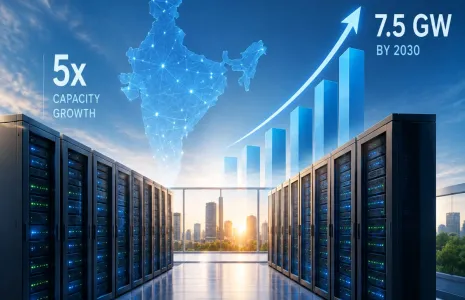
Mumbai, Nov. 9 -- India's data centre capacity is projected to increase five-fold to around 7.5 gigawatts (GW) by March 2030, attracting more than Rs. 3 tn in investments over the next four financial years, according to Crisil Ratings. The expansion is being driven by generative artificial intelligence (GenAI), enterprise digitalisation and rising data consumption.
Nearly half of the upcoming capacity has already been committed through long-term contracts, reducing speculative development and offtake risk. More than 95 per cent of capacity under construction is contracted, while existing facilities are operating at around 90 per cent utilisation. Longer contract tenors of 15 to 20 years, compared with 10 to 12 years earlier, are also improving revenue visibility.
India's development costs are around 20 per cent lower than those in several competing Asia-Pacific markets because of relatively competitive land, construction and labour costs. Lower power tariffs allow rental rates to remain 30 to 35 per cent below those in peer markets. Large campuses powered by renewable energy are further strengthening the country's appeal to hyperscalers seeking to meet sustainability commitments.
However, power infrastructure remains a key execution risk. Almost three-fourths of approximately 6 GW of upcoming capacity is expected to be concentrated in Visakhapatnam, Mumbai and Hyderabad. By fiscal 2030, data centre capacity in the three cities could equal around 80 per cent, 60 per cent and 20 per cent, respectively, of their current peak electricity demand, making timely grid connectivity and transmission upgrades essential.
Hyperscalers' share of leased capacity is expected to rise to 75 to 80 per cent by fiscal 2030 from 60 to 65 per cent in fiscal 2026, increasing customer concentration and bargaining-power risks. Developers also face substantial upfront capital expenditure, with investments typically preceding cash flows by 24 to 36 months. Crisil Ratings said strong pre-commitments, rising utilisation and cost advantages could support credit stability, but returns will depend on securing power, obtaining approvals, controlling costs and upgrading facilities for higher-density GenAI workloads.
Published by HT Digital Content Services with permission from Construction World.