
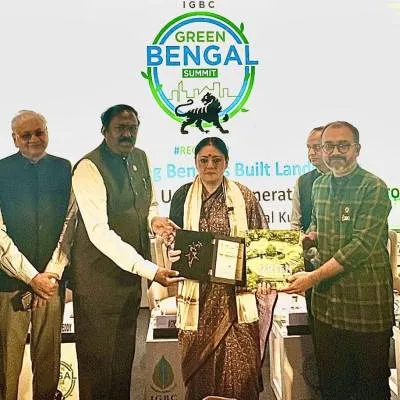
Mumbai, Nov. 14 -- The Confederation of Indian Industry's Indian Green Building Council (CII IGBC) organised the Green Bengal Summit 2026 in Kolkata on 13 November, bringing together policymakers, government representatives, developers, architects, urban planners and sustainability experts to discuss sustainable and climate-resilient development in West Bengal.
Held at Taj Taal Kutir under the theme 'Future-Proofing Bengal: Vision for Sustainable and Resilient Growth', the summit focused on integrated urban development, climate resilience, urban regeneration and Net Zero carbon pathways. Discussions covered the need to align infrastructure, housing and industrial growth with environmental sustainability.
Addressing the inaugural session, Agnimitra Paul, Minister-in-Charge, Department of Urban Development and Municipal Affairs, Government of West Bengal, highlighted the challenges posed by rapid urbanisation, changing rainfall patterns, urban flooding, heatwaves and deteriorating air quality. She called for climate-responsive planning and said the state intended to extend its green city initiatives beyond Kolkata to emerging urban centres such as Durgapur, Asansol, Howrah and Siliguri. She also emphasised municipal waste management, circular construction, wetland conservation and energy-efficient buildings.
Vibhu Goel, Managing Director, WBHIDCO, cited New Town, Kolkata, as an evolving urban ecosystem and highlighted the need to integrate resilience into urban planning. He pointed to initiatives such as Sponge City principles for stormwater management, green infrastructure, passive cooling, building retrofits, embodied carbon reduction and renewable energy integration.
C Shekar Reddy, National Chairman, CII IGBC, called for wider adoption of green building practices across West Bengal, particularly in Tier-II and Tier-III cities. He highlighted the potential for policy incentives to encourage green building ratings in the manufacturing sector, MSMEs and affordable housing. He also stressed the importance of retrofitting existing buildings, promoting Net Zero developments and encouraging young innovators.
Tapas Roy, Minister-in-Charge of the Departments of Industry, Commerce and Enterprises; Public Enterprises and Industrial Reconstruction; and Non-Conventional and Renewable Energy Sources, Government of West Bengal, highlighted the need to balance industrial expansion with environmental responsibility. He said sustainability should be viewed as an opportunity to improve innovation, efficiency and competitiveness rather than merely as a regulatory requirement.
The inaugural session also included discussions on the role of the real estate sector, green-to-Net Positive development, resilience and industrial sustainability. Speakers included Apurva Salarpuria, President, CREDAI Kolkata; Sushil Mohta, Immediate Past Chairman, IGBC Kolkata; Debashis Dutta, Chairman, CII Eastern Region Committee on Logistics and Infrastructure; and Ravi Dugar, Co-Chairman, IGBC Kolkata.
Technical sessions examined sustainable cities, resilient urban growth, green retrofits, sustainable building materials, energy and water efficiency, and India's Net Zero mission. A special plenary discussed the challenges and opportunities for advancing Net Zero development in the state.
The 'My City, I Care - Innovator's Showcase' presented grassroots solutions shortlisted through the Green Bengal Innovation Challenge. Ten ideas were presented, with the top five showcased and winners recognised. The programme also included the Green Crusaders Awards 2026, which recognised projects and project teams participating in IGBC's special registration initiative for green building adoption in Bengal.
The summit concluded with a call for greater collaboration among government, industry, developers, technology providers and citizens to accelerate the transition towards a resource-efficient and climate-resilient built environment.
Published by HT Digital Content Services with permission from Construction World.