
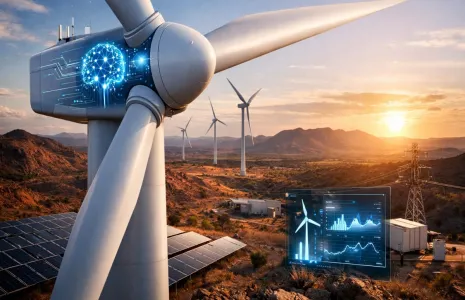
Mumbai, July 21 -- Envision Energy has announced that it has developed its first grid-connected artificial intelligence wind turbine prototype for Fortescue's Nullagine Wind Project in the Pilbara. The prototype supports Fortescue's inaugural operational wind development and marks an expansion of Envision's presence in the Australian renewable energy market through deployment of its Physical AI system for industrial decarbonisation. The company presented the initiative as part of efforts to apply AI to energy systems nationwide.
The project comprises 17 Envision EN182 turbines rated at seven point eight Megawatt (MW) each, engineered for mining and desert environments, local wind regimes and stringent grid requirements. The turbine design integrates Nabrawind's self-erecting tower technology with a hub height of 188 metre, which Envision positioned as a global benchmark for onshore wind and a means to unlock higher energy yield. Local adaptation and robust erection methods were described as central to meeting operational demands in the Pilbara.
At the core of the technology stack is the Dubhe Energy Foundation Model, which Envision described as the world's largest Physical AI system, and which was unveiled by founder and chief executive Lei Zhang at Abu Dhabi Sustainability Week. Dubhe is reported to operate in concert with Envision's Tianji Weather Foundation Model to analyse real-world energy data streams and to orchestrate renewable generation, energy storage, grid operations and electricity demand in real time. Envision asserted that the models enable renewable resources to be harnessed while driving system costs toward near-zero marginal levels.
The company noted that AI adoption across wind operations and maintenance has accelerated, with techniques such as machine learning, deep learning, digital twins and SCADA-based predictive analytics used to reduce unplanned downtime, extend component life and improve energy output. Envision's international product line president characterised the grid connection as validation of the Physical AI approach and a scalable blueprint for industrial decarbonisation. Fortescue's chief executive highlighted that the Nullagine Wind Project will integrate with Pilbara Energy Connect to balance daytime solar with night-time and seasonal wind generation and to displace diesel and gas across haul fleets and processing sites.
Published by HT Digital Content Services with permission from Construction World.