
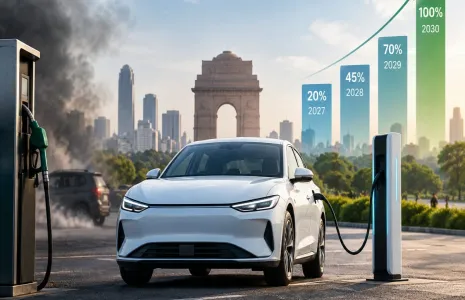
Mumbai, Oct. 21 -- A panel formed by the Commission for Air Quality Management (CAQM) has proposed that all new private passenger vehicles sold in Delhi-NCR should be zero-tailpipe-emission models by 2030. The recommendation sets interim targets of 20% of new sales in 2027, 45% in 2028 and 70% in 2029 before reaching 100% in 2030.
Led by IIT Madras professor Ashok Jhunjhunwala, the Expert Committee on Vehicular Emission submitted its recommendations to CAQM, which will decide whether the measures can be implemented. The proposal has intensified a debate between supporters of battery-electric vehicles and industries representing compressed natural gas, ethanol and compressed biogas.
The 15-member committee included former AIIMS director Randeep Guleria as co-chair, along with representatives from IITs, government ministries, NITI Aayog and research organisations. It said Delhi-NCR's air pollution affects people across age groups, with the air quality index crossing 460 and winter PM2.5 concentrations reaching nearly 35 times the World Health Organization's guideline level.
The panel has also recommended timelines for taxis, light commercial vehicles, buses and trucks. Its proposals include an immediate phase-out of BS-I to BS-III vehicles, followed by BS-IV vehicles by 2030, BS-VI two-wheelers by 2035 and BS-VI four-wheelers by 2040. The recommendations come as Delhi's electric-vehicle policy 2.0 already provides for passenger-vehicle mandates.
Seven industry bodies representing the ethanol, biogas and city-gas sectors have opposed the proposed approach, arguing that the policy should remain technology-neutral. They said ageing vehicles, particularly those manufactured before BS-VI standards, account for more than 95% of Delhi's vehicular pollution load, citing data submitted by CAQM to the Supreme Court in December 2025.
Maruti Suzuki, Tata Motors Passenger Vehicles and Hyundai Motor India have advocated a multi-fuel transition in recent years. The industry bodies also raised concerns about the consultation process and said alternative fuels had not received a fair hearing. The panel, however, has maintained that successive emission-standard upgrades have not stopped the growth in vehicle numbers or resolved Delhi's pollution crisis.
Published by HT Digital Content Services with permission from Construction World.