
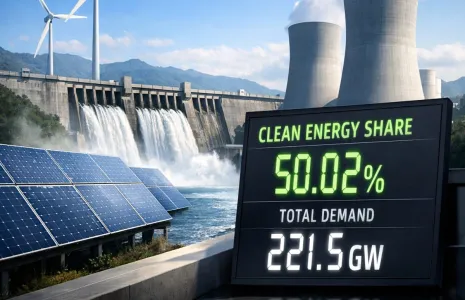
Mumbai, July 14 -- India's electricity grid recorded a milestone on July six when clean energy sources accounted for 50.02 per cent of national demand at 11:46 am, according to data from the power ministry's Merit Order Despatch of Electricity for Rejuvenation of Income and Transparency (MERIT). At that instant total demand stood at 221.5 gigawatt (GW). The figure marks the second consecutive year that non-fossil sources including renewable energy, hydropower and nuclear have met more than half of peak demand and reflects shifting supply dynamics.
Clean sources have supplied over 45 per cent of total electricity demand for 50 days since May, the Council on Energy, Environment and Water (CEEW) noted via fellow Disha Aggarwal, who said this signals a lasting change in the supply mix. CEEW research points to the need to scale flexible energy storage along with large-scale and distributed renewable systems to meet rising evening demand with low-cost renewables.
Peak power demand eased to 222.5 GW as of July six as rainfall across the country cooled temperatures, state-run Grid Controller of India data show. On July seven peak demand rose to 230 GW. Demand remains below the all-time high of 270.8 GW recorded in May, and the government has estimated peak demand could touch 271 GW in 2026.
India's total installed capacity was 542.3 GW as of May 31, with thermal capacity at 250.8 GW and renewable capacity at 282.7 GW. Analysts say shortfalls become most challenging in evening hours due to the non-availability of solar power and that increasing storage and flexibility will be vital. Experts also warned that an El Nino phase, characterised by warmer-than-normal Pacific sea temperatures, may bring harsher summer conditions and lift power demand.
Published by HT Digital Content Services with permission from Construction World.