
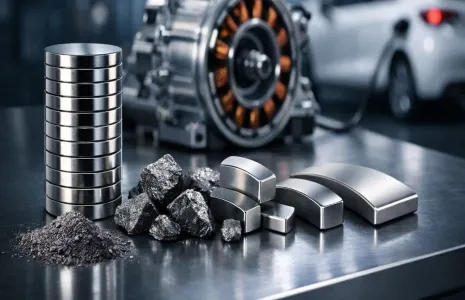
Mumbai, June 30 -- The Centre has extended a rare earth permanent magnet tender by one-month as companies seek extra time to firm up technology access and feedstock plans. The extension comes as the government seeks to localise magnet production to support electric vehicle traction motors and reduce dependence on imports. The move follows approval of a manufacturing programme designed to build domestic capability in a component deemed critical across multiple sectors.
The scheme has a financial outlay of Rs 72.8 billion, comprising a Rs 7.5 billion capital subsidy and Rs 64.5 billion in sales-linked incentives over five years. Eligible manufacturers can claim incentives of up to 40 per cent of eligible net sales, while the three lowest bidders will receive limited assured supplies of Neodymium-Praseodymium (NdPr) oxide from state-owned IREL (India) Ltd. The government plans to select up to five beneficiaries with capacities ranging from 600 tonnes per annum (t) to 1,200 t to build an overall domestic manufacturing capacity of 6,000 t.
Industry executives say technology remains the principal hurdle rather than machinery procurement. Sintered Neodymium-Iron-Boron (NdFeB) magnets require specialised powder metallurgy, including alloy preparation, micron-level powder production, oxygen-controlled processing, vacuum sintering and precision heat treatment. Those manufacturing processes are protected intellectual property largely held by a handful of global players, making credible technology partnerships essential to produce magnets that meet demanding quality standards and to clear customer qualification cycles that can take between 12 and 24 months.
Feedstock security is also prompting caution among potential investors. Although limited assured supplies of NdPr oxide are on offer, access to heavy rare earths such as dysprosium and terbium for high-performance magnets remains concentrated globally, exposing manufacturers to geopolitical risk. Industry observers said the one-month extension reflected companies taking additional time to address technology access, raw material security and execution risks before committing to one of India's most ambitious manufacturing programmes.
Published by HT Digital Content Services with permission from Construction World.