
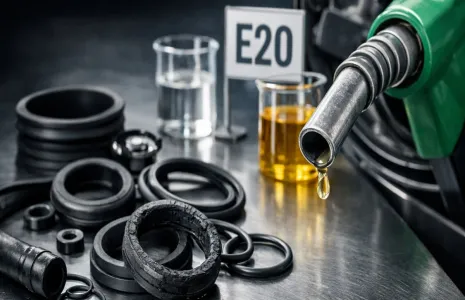
Mumbai, Aug. 3 -- The government has told the Rajya Sabha that some rubber components and gaskets in Bharat Stage III (BS-III) vehicles introduced on 1 April 2005 and manufactured before 2016 may require replacement when those vehicles are operated with E20 fuel, which contains eighty per cent petrol and twenty per cent ethanol. Road Transport and Highways Minister Nitin Gadkari provided a written reply and indicated that such replacements can be accommodated within routine servicing schedules.
A joint evaluation of the effects of E20 on two-wheelers and four-wheelers was carried out by Indian Oil Corporation Limited (IOCL), the Indian Institute of Petroleum (IIP) Dehradun, the Society of Indian Automobile Manufacturers (SIAM) and the Automotive Research Association of India (ARAI). The study findings reportedly did not indicate a need to modify car or two?wheeler engines and found no significant variations in performance or abnormal wear and tear in legacy vehicles when assessed with E20 fuel.
The minister noted that tests did not reveal issues in drivability, startability, metal compatibility or plastic compatibility. Only in the case of pre?2016 BS-III models did some rubber items show potential for earlier replacement, a matter that the ministry said can be managed through normal maintenance. An Inter?Ministerial Committee convened under Niti Aayog on 26 December 2020 examined compatibility and mileage aspects and produced the Roadmap for Ethanol Blending in India 2020?25 following consultations with manufacturers, oil companies and agricultural experts.
The Ethanol Blended Petrol programme commenced with a pilot in 2001 and E5 was introduced in 2006, with blending remaining around one point five three per cent until 2013?14 before gradual increases as capacity, infrastructure and regulation were developed. Before the April 2026 introduction of E20, laboratory studies, durability trials and field validation addressed material compatibility, engine durability, fuel systems, emissions and fuel economy. The government reiterated that the rollout has been phased and supported by testing while manufacturers continue to honour warranty claims.
Published by HT Digital Content Services with permission from Construction World.