
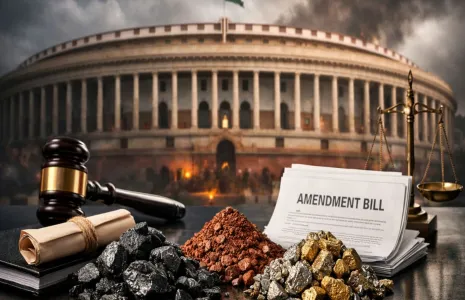
Mumbai, Aug. 18 -- The Union government introduced the Mines and Minerals (Development and Regulation) Amendment Bill, 2026 in the Lok Sabha to bar state governments from imposing taxes, cesses or levies on mineral rights and mineral-bearing lands. The measure was described as necessary to prevent excessive and unpredictable taxation that the government said would make the sector commercially unviable. The bill was tabled during the Monsoon session amid protests.
The amendment seeks to give the Centre greater regulatory command over mines and to extend that reach to mineral-bearing lands for the sustainable and uniform development of minerals. Opposition leaders argued the proposal would undermine state fiscal powers and federalism and urged a detailed scrutiny. A Congress MP asked that the bill be referred to the Parliamentary Standing Committee on Coal, Mines and Steel for closer examination.
The draft follows a July 2024 Supreme Court ruling that upheld the power of states to levy taxes on mineral rights and mineral-bearing lands separate from royalty under the Mines and Minerals (Development and Regulation) Act, 1957 (MMDR Act). The court held that royalty under the Act was not a tax and that the Act did not limit state legislative power to impose levies. The court later permitted states to recover past dues over 12 years beginning April one, 2026 while barring penalties and additional interest.
Industry observers estimated a financial impact in a range of Rs one and a half to two trillion (tn), with public sector undertakings facing a burden of roughly Rs 700 billion (bn). The retrospective recoveries from April one, 2005 have been contested by the Centre and private mining entities and remain subject to litigation. The bill proposes a new section to invalidate state levies that are uncollected or undeposited as of the amendment coming into force while preserving levies already collected.
The amendments also empower the Centre to frame conditions for any state levies and to regulate mineral-bearing lands in accordance with MMDR Act parameters, which the government said would curb unbalanced taxation and supply chain distortion. Critics and environmental experts warned that shifting regulation from mines to mineral-bearing land could constrain state capacity to levy charges for environmental remediation and public health. Lawmakers continue to press for committee review to safeguard state fiscal space and ecological protections.
Published by HT Digital Content Services with permission from Construction World.