
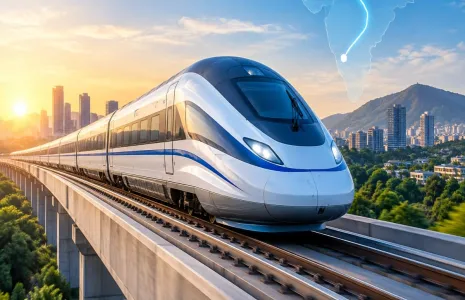
Mumbai, Nov. 5 -- Union Railway Minister Ashwini Vaishnaw has indicated that the proposed Bengaluru-Pune bullet train corridor could be included among India's next high-speed rail projects. He said another 3,000 km of bullet train corridors were planned for announcement in the coming years as the country advances towards the goal of Viksit Bharat.
Vaishnaw was speaking after flagging off the inaugural Bengaluru-Mumbai Vande Bharat Sleeper Express. He said Prime Minister Narendra Modi had approved 4,000 km of bullet train corridors, with additional routes expected to connect major economic and technology centres across the country.
The proposed Bengaluru-Pune corridor would run across Karnataka, connecting Bengaluru with Hubballi before continuing to Pune. Vaishnaw also referred to a southern high-speed rail corridor linking Bengaluru, Hyderabad, Amaravati and Chennai, saying it would bring the region's large economies and technology capitals closer together.
Under the proposed southern corridor, the journey from Bengaluru to Chennai would take 73 minutes, while travel from Bengaluru to Hyderabad would take two hours and 10 minutes. Vaishnaw said the faster connections would support economic integration and create a multiplier effect for states in southern India.
He separately announced that the Bengaluru-Mangaluru Vande Bharat Express would be introduced within the next few weeks. Electrification and testing on the route have been completed, he said, adding that the service would improve rail access to coastal Karnataka, including Mangaluru, Udupi and areas towards Karwar and Goa.
Union Ministers Pralhad Joshi and H D Kumaraswamy, Ministers of State V Somanna and Shobha Karandlaje, and Members of Parliament Tejasvi Surya, P C Mohan and C N Manjunath were among those present. Vaishnaw also highlighted railway station redevelopment, Bengaluru's suburban rail network, metro expansion, semiconductor and electronics manufacturing, and growing defence production as part of India's broader infrastructure and self-reliance efforts.
Published by HT Digital Content Services with permission from Construction World.